Blog
Silicone Leather Coating System: Materials, Process and Applications

Primary keyword: silicone leather coating
Recommended URL: /silicone-leather-coating
Introduction
Silicone leather coating is an advanced manufacturing solution used to create high-performance synthetic leather with excellent durability, soft hand feel, and long-term surface stability. Compared with traditional PU or PVC leather, silicone leather offers a more premium touch, better weather resistance, stronger abrasion performance, and improved environmental characteristics. As market demand continues to shift toward safer, cleaner, and more durable materials, silicone leather coating has become an important direction for manufacturers of upholstery, fashion materials, industrial textiles, and specialty coated fabrics.
A complete silicone leather coating system is not based on a single material. Instead, it is built on a layered formulation structure designed to balance substrate bonding, wear resistance, surface appearance, and hand feel. In practical production, manufacturers usually work with a full system that includes base coat silicone, middle coat silicone, top coat silicone, and surface additives. Each layer plays a different role, and proper material matching is essential for achieving stable production and consistent finished quality.
What Is Silicone Leather Coating?
Silicone leather coating refers to the process of applying silicone-based materials onto a textile or synthetic substrate to produce leather-like coated materials. These coated materials are often used where a combination of softness, durability, and surface performance is required.
In a typical silicone leather structure, the coating is built step by step. The lower layer is responsible for bonding to the substrate, the middle layer contributes to mechanical strength and abrasion resistance, and the top layer determines the final hand feel and appearance. Surface additives may then be used to adjust dry touch, anti-soiling behavior, matte effect, or other finishing properties.
Because silicone materials are highly versatile, silicone leather coating can be adapted for different target effects. Some applications require a smooth and silky hand feel, while others need a dry-touch matte finish. Some customers focus on abrasion resistance, while others care more about clean touch, anti-soiling performance, or compatibility with specific production lines. This is why a system-based approach is more effective than selecting a single silicone product in isolation.
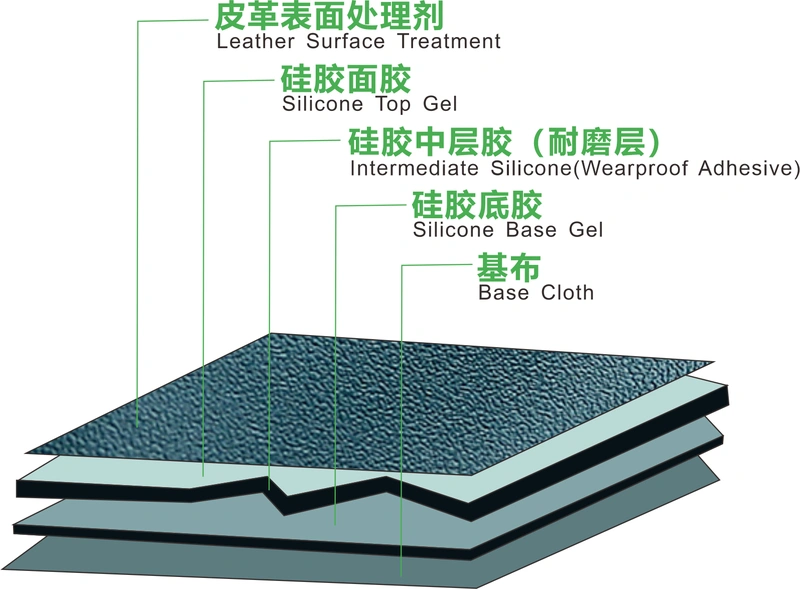
Typical Silicone Leather Coating Structure
A typical silicone leather coating system includes the following structure:
Substrate → Base Coat → Middle Coat → Top Coat → Surface Additive → Embossing / Finishing
This layered design helps manufacturers control both process performance and final surface quality.
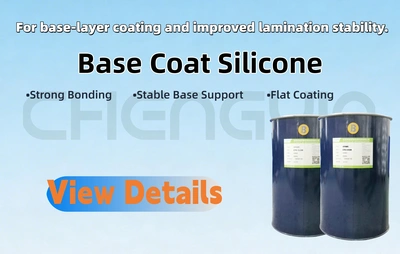
1. Base Coat Silicone
The base coat is the foundation of the system. Its main function is to create stable adhesion between the substrate and the silicone coating structure above it. A good base coat should provide reliable bonding, good leveling, and suitable support for subsequent layers.
In synthetic leather production, the base coat is especially important when coating onto microfiber, base fabrics, imitation leather structures, or other textile substrates. If base-layer bonding is unstable, the whole coating structure may suffer from delamination, edge lifting, or poor durability. Therefore, base coat selection should be based on several key factors, including viscosity, compatibility with the substrate, and whether the curing conditions match the production line speed and baking temperature.
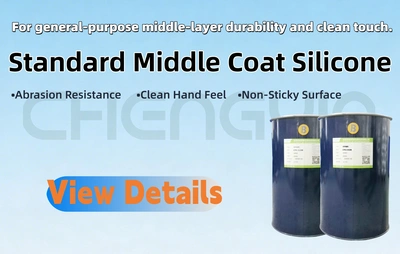
2. Middle Coat Silicone
Many buyers focus on the top coat, but the middle coat is often the real performance core of the silicone leather system. It plays a key role in thickness build-up, abrasion resistance, mechanical strength, and overall structural stability. In many applications, poor wear performance is not caused by the top coat alone, but by the failure of the middle layer under friction, repeated use, and long-term surface stress.
For this reason, middle coat selection should be based on the actual end-use requirements. Applications such as office chairs, which are exposed to daily sitting and constant friction, usually require a higher-performance middle coat than products like bags that are used only occasionally. Where higher wear resistance, better tear strength, and longer service life are needed, a high-performance middle coat is typically preferred. For general-purpose applications, a standard middle coat may be sufficient to balance cost and durability.
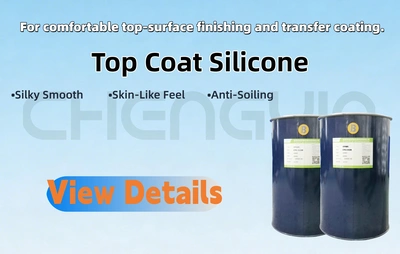
3. Top Coat Silicone
Top coat may sound simple, but in practice it is both simple and challenging. It is simple because there are only a few mainstream surface feel options: smooth, dry, and velvety. The challenge lies in how to make a “smooth” feel without making it greasy, and how to make a “dry” feel without making it rough or harsh to the touch.
Top coat also plays a major role in surface stain resistance. For example, whether ballpoint pen marks can be wiped off, or whether spilled coffee will penetrate the surface, largely depends on the top coat. So when a customer asks, “Is this leather easy to maintain?”, the answer is usually found in the top coat.
4. Surface Additives
Surface treatment is the final step in the process, and also the layer with the greatest room for adjustment. If the hand feel after the top coat is still not quite right, or if the customer feels the surface attracts dust too easily, looks too glossy, or is not dry-smooth enough, these issues are usually fine-tuned at the surface treatment stage.
For example, some surface treatment agents are semi-silicone based, which means they can also be used with PU systems and are suitable for surface finishing on composite materials. Full-silicone surface treatment agents, on the other hand, are specially designed for full-silicone leather systems, offering the best compatibility and avoiding problems such as wrinkling or delamination after application.
Which one to use depends on the type of top coat system you have and the final effect you want—whether it is matte appearance, anti-soiling performance, or simply a drier and cleaner hand feel.
Silicone Leather Manufacturing Process
Although exact production conditions vary by formula and equipment, a typical silicone leather manufacturing process follows a structured sequence:
Step 1: Substrate Preparation — The substrate must be clean, dry, and stable enough for coating. Depending on the product design, manufacturers may use microfiber, textile base fabrics, coated fabrics, or other synthetic leather substrates.
Step 2: Base Coat Application — The base coat is applied first to create bonding and establish the foundation of the coating system. Viscosity and coating method are selected according to substrate type and production equipment.
Step 3: Middle Coat Application — The middle coat is then applied to build thickness, durability, and wear resistance. In higher-performance structures, this layer may be optimized for stronger abrasion or improved mechanical behavior.
Step 4: Top Coat Application — The top coat is applied to achieve the target hand feel and surface appearance. This stage is critical for defining the tactile and visual identity of the final product.
Step 5: Surface Finishing — If needed, surface additives or finishing modifiers are introduced to further adjust dry touch, anti-soiling performance, or matte/gloss characteristics.
Step 6: Embossing and Final Surface Treatment — Depending on the final design, embossing or release-paper transfer finishing may be used to create texture, matte effects, or specific visual patterns.
In simple terms, the logic of this layered coating structure is to break a complex problem into manageable parts—bonding, strength, hand feel, and surface effect—so that each step can be controlled and optimized separately. If a problem occurs on the production line, it is also much easier to identify where the adjustment should be made.
Advantages of Silicone Leather Coating
The advantages of silicone leather can be summed up in two points: better performance and better user experience. In terms of performance, it offers excellent abrasion resistance, weather resistance, and hydrolysis resistance, making it far more durable than PU leather. In terms of user experience, it has a soft and warm touch—it does not feel cold in winter like PVC, nor does it become sticky over time like some PU materials. In addition, its dense surface makes it less likely to absorb stains, which makes it especially suitable for households with children.
That said, these advantages only become real if the formulation is done properly. If the base coat does not bond well, the middle coat cannot provide enough support, or the top coat fails to deliver the right hand feel, then all of those benefits are lost.
Typical Applications of Silicone Leather Coating
Silicone leather is no longer just a concept on paper. It has already begun replacing traditional materials on a large scale in places people can actually see and touch.
High-end automotive interiors: This is currently its most important battleground. Brands such as Mercedes-Benz, Geely, and FAW have already started, or are actively planning, to use silicone leather for seats, steering wheels, and other interior components. Why? Because it does not have the odor associated with traditional leather (low VOCs), it does not become excessively hot or age quickly under strong summer sunlight, and its abrasion resistance continues to improve through new technologies, such as FAW’s patented nano-molybdenum disulfide approach, which addresses the early weakness of limited wear resistance.
Public transportation and public facilities: This is a very interesting emerging application. The public lounge sofas in Terminal 3 of Guangzhou Baiyun International Airport have already fully adopted silicone leather. Just imagine an airport with huge passenger flow, frequent drink spills, and high cleaning requirements—silicone leather’s easy-clean, weather-resistant, and flame-retardant properties make it almost tailor-made for this kind of environment.
Medical, baby, and home applications: Because it is non-toxic, antibacterial, and mold-resistant—not due to a surface coating, but because of the material’s own inherent properties—it is becoming increasingly popular in hospital beds, rehabilitation equipment, children’s dining chairs, and high-end furniture. Especially in the post-pandemic era, when hygiene has become a greater priority, demand in this area is growing rapidly.
How to Choose Silicone Leather Coating Materials
Customers often ask, “Which is your best silicone?” In reality, that is a difficult question to answer, because there is no such thing as the “best” silicone—only the most suitable combination. Material selection mainly depends on a few key factors.
First, what is the base fabric?
The base coat used for microfiber is completely different from the one used for ordinary polyester fabric. Microfiber has a relatively smooth surface, so the base coat must be able to wet and anchor into it properly. Knitted fabrics, on the other hand, tend to absorb more easily, so the viscosity of the base coat usually needs to be higher to prevent excessive penetration.
Second, what kind of hand feel is required?
Should the final surface feel smooth, dry, or velvety? This is mainly determined by the top coat, but the surface treatment layer can also be used for fine adjustment. For example, if the top coat turns out a bit too smooth, but the customer wants a drier touch, a suitable surface treatment agent can help correct that.
Third, how will the end product be used?
If it is for an office chair that will be used every day, abrasion resistance becomes a key requirement, which means the middle coat may need to be thicker or upgraded to a higher-performance grade. If it is for a decorative bag that is only handled occasionally, then a standard middle coat is usually sufficient.
Once these points are clear, it becomes much easier to match the right base coat, middle coat, top coat, and surface treatment system without going in the wrong direction. It is not a matter of saying, “I want the most expensive one” from the start—because if a premium material is used in the wrong place, the result may still be worse than a standard grade used correctly.
FAQ
Q1:What is the difference between silicone leather and PU leather?
The main differences can be summarized in three aspects:
Durability:
Silicone leather offers excellent weather resistance, hydrolysis resistance, and high-temperature resistance. It can be used outdoors for years without cracking. PU leather, by contrast, is more likely to undergo hydrolysis and become sticky in humid or high-temperature environments.
Surface performance:
Silicone leather has a dense surface that is less likely to absorb stains. Even ballpoint pen marks can often be wiped off. PU leather is more prone to absorbing oil and color, which makes cleaning more difficult.
Hand feel:
Silicone leather tends to have a fuller, warmer, and more substantial touch. PU leather can be made very soft and thin, but it is more likely to lose elasticity over time.
The main drawback of silicone leather is its higher cost. At present, it is mainly used in high-end furniture, automotive interiors, medical rehabilitation products, and other fields where durability and environmental performance are especially important.
Q2:Why is a layered silicone leather coating system important?
Because each layer performs a different function: the base coat is responsible for bonding, the middle coat provides strength and abrasion resistance, the top coat determines the hand feel, and the surface treatment agent is used for final surface adjustment. If everything is combined into a single layer, it becomes very difficult to balance all these properties at the same time. For example, trying to achieve both strong adhesion and excellent hand feel in one layer often means neither is done well.
Q3:Can silicone leather coating be applied to different substrates?
Yes. It depends on the substrate type and the target performance, and base coat selection is especially critical for substrate compatibility. For example, microfiber and ordinary polyester fabric require different types of base coat: the former needs a base coat with good wetting ability, while the latter may require viscosity adjustment to prevent excessive penetration.
Q4:How do I choose between smooth and dry-smooth top coats?
It mainly depends on the end-use application:
Smooth top coat:
Suitable for products such as sofas, upholstered panels, and garments that have large-area skin contact. It provides a finer, softer, and more skin-friendly touch. The drawback is that the surface is more likely to show fingerprints, and its anti-soiling performance is relatively weaker.
Dry-smooth top coat:
Suitable for applications such as steering wheels, phone cases, and mouse pads, where hands tend to sweat easily or where anti-slip performance is needed. The surface feels dry and clean, does not feel sticky, and is less likely to show fingerprints. It also usually offers better anti-soiling performance.
If you are not sure, it is best to start with a small sample test—apply both top coats on the same substrate, then compare them by touch and by simple stain or pen-mark tests to see which one better matches your final application needs.
Q5:What causes instability in silicone leather coating production?
Common causes include substrate incompatibility, improper viscosity selection, unreasonable layer matching, or curing inhibition (“poisoning”). Using a complete and well-matched system can effectively reduce these risks. For example, if the middle coat is applied before the base coat is fully cured, it may lead to poor interlayer adhesion. In another case, if a slip additive from the top coat migrates into the middle layer, it can also negatively affect bonding.
Conclusion
Silicone leather cannot be done properly with just a single layer. A truly mature product relies on the coordination of four layers: base coat, middle coat, top coat, and surface treatment. The base coat ensures firm bonding to the substrate, the middle coat provides thickness and abrasion resistance, the top coat determines the hand feel, and the surface treatment makes the final fine adjustment to the surface effect.
The advantage of this layered structure is clear: if you want to change a certain performance or effect, you can adjust the corresponding layer without having to redesign the entire formula from scratch. This improves production stability, speeds up development, and makes it easier to achieve both the desired hand feel and long-term durability.
If you are developing silicone leather and are not sure how to select the right system, or if you want to verify the effect of a specific layer combination, feel free to send us your substrate samples. We can help recommend a suitable system and arrange sample testing.
Recommended Products