


Blog
Why Is a Middle Layer Necessary for Silicone Heat Transfer Labels?

Silicone heat transfer labels are widely used on sportswear, garments, bags, shoes, gloves, and other textile products. They provide a soft touch, excellent elasticity, and a high-quality three-dimensional appearance.
However, producing a durable silicone heat transfer label is not as simple as printing silicone and then applying hot melt adhesive directly.
One of the most important steps is applying a middle layer between the silicone and the hot melt adhesive.
In this article, we will explain why this layer is necessary and what may happen if it is omitted.
Structure of a Silicone Heat Transfer Label
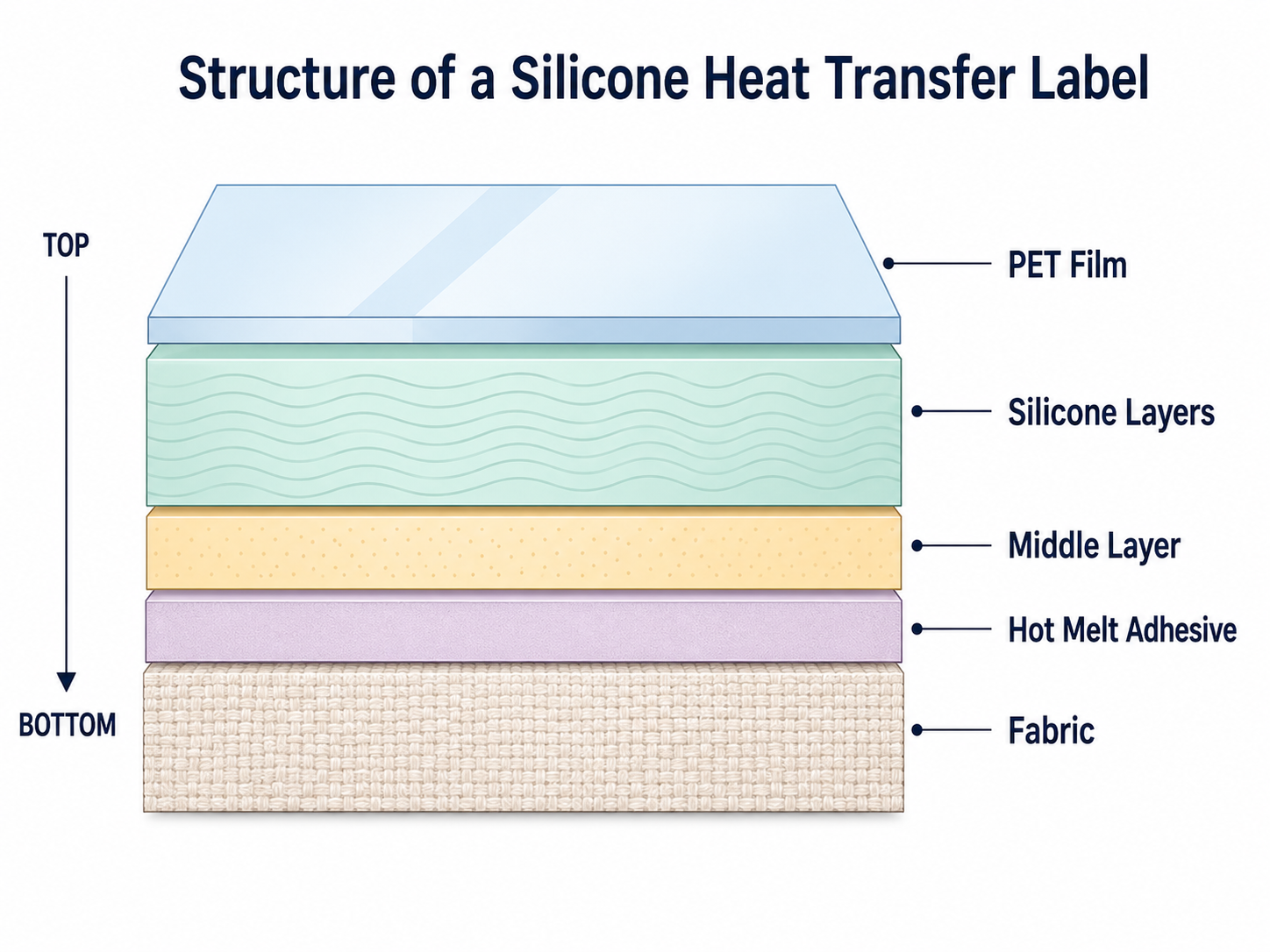
A typical silicone heat transfer label may include the following layers:
- Release PET film
- Colored silicone layer
- Building or thickness silicone layers
- Middle bonding layer
- Hot melt adhesive layer
Each layer performs a different function.
The silicone layers create the color, shape, thickness, softness, and three-dimensional effect of the logo. The hot melt adhesive allows the finished label to be transferred and bonded onto the fabric.
The middle layer connects these two different material systems.
Why Can’t Hot Melt Adhesive Bond Directly to Silicone?
Silicone has naturally low surface energy. This gives silicone many useful properties, such as:
- Water resistance
- Chemical resistance
- Softness and flexibility
- Non-stick performance
- Stable performance at high temperatures
However, the low surface energy also makes silicone difficult to bond with many conventional adhesives.
Most hot melt adhesives cannot form a sufficiently strong bond directly with a cured silicone surface. Even when the adhesive appears to stick initially, it may separate after stretching, washing, heating, or repeated use.
This is why a suitable middle bonding layer is required.
What Is the Function of the Middle Layer?
The middle layer acts as a bridge between the silicone and the hot melt adhesive.
Its main functions include:
1. Improving Adhesion to Silicone
The middle layer is specially formulated to create better adhesion to the silicone surface.
It helps prevent the hot melt adhesive layer from peeling away from the silicone logo.
2. Connecting Two Different Materials
Silicone and hot melt adhesive have very different chemical and physical properties.
A suitable middle layer improves compatibility between them and allows the complete transfer structure to remain stable.
3. Improving Washing Durability
Without sufficient adhesion between the layers, the label may delaminate after washing.
A properly applied and cured middle layer improves the label’s resistance to:
- Repeated washing
- Stretching
- Bending
- Rubbing
- Temperature changes
4. Reducing the Risk of Layer Separation
Layer separation is one of the most common problems in silicone heat transfer label production.
The silicone design may remain attached to the garment, while the adhesive layer separates from the back of the silicone. In other cases, the entire label may peel off after washing.
A compatible middle layer significantly reduces this risk.
What Happens If the Middle Layer Is Not Used?
If hot melt adhesive is printed directly onto silicone without a compatible bonding layer, several problems may occur:
- The hot melt adhesive cannot properly bond with the silicone
- The adhesive layer peels away easily
- The label fails during stretching tests
- The logo separates after washing
- Bonding strength becomes unstable
- The finished transfer cannot meet durability requirements
Sometimes the label may look normal immediately after production, but the bonding problem only appears after heat pressing or washing.
Therefore, adhesion testing should always be carried out before mass production.
How Should the Middle Layer Be Applied?
The specific application method depends on the silicone system, middle-layer material, and hot melt adhesive being used.
A general production procedure is:
- Fully cure the printed silicone layers.
- Apply the middle bonding layer evenly.
- Cure or dry the middle layer according to the recommended conditions.
- Apply a compatible hot melt adhesive.
- Dry the hot melt adhesive completely.
- Perform heat-transfer and washing tests.
The middle layer should cover the required bonding area evenly. Insufficient coating, incomplete curing, contamination, or incorrect application temperature may reduce adhesion.
Choosing the Right Hot Melt Adhesive Is Also Important
Using a middle layer does not mean that every hot melt adhesive will work.
The hot melt adhesive must also be suitable for:
- Silicone heat transfer labels
- The target fabric
- The required heat-pressing temperature
- Washing conditions
- Stretchability requirements
- The production process
For example, the adhesive used for cotton fabric may perform differently on polyester, nylon, or elastic fabrics.
Before mass production, the complete system should be tested together:
Silicone + middle layer + hot melt adhesive + target fabric
Changing any one of these materials may affect the final bonding result.
Common Causes of Poor Adhesion
Poor bonding is not always caused by the middle layer itself. Other possible reasons include:
- The silicone surface is contaminated
- The silicone is not fully cured
- The middle layer is applied too thinly
- The middle layer is over-cured or under-cured
- The hot melt adhesive is incompatible
- The hot melt adhesive is not completely dried
- Heat-pressing temperature is too low
- Heat-pressing pressure is insufficient
- Heat-pressing time is too short
- The adhesive is not suitable for the target fabric
When solving an adhesion problem, all production parameters should be checked systematically.
Conclusion
The middle layer is an essential part of many silicone heat transfer label systems.
Its purpose is to create a reliable connection between the silicone and the hot melt adhesive. Without a compatible middle layer, the hot melt adhesive may not bond firmly to the silicone, resulting in peeling, delamination, and poor washing durability.
For stable production, manufacturers should use a complete and compatible material system and test it on the actual fabric before mass production.
Chengyin Silicone provides silicone materials and technical support for silicone heat transfer labels, including silicone inks, bonding materials, and application guidance.
For product recommendations or sample testing, contact us:
WhatsApp: +86 13538326617
Website: www.cysiltech.com