


Blog
Properties of Liquid Silicone: A Complete Guide

Liquid silicone is a flowable silicone-based material that can be molded, coated, printed, cast or dispensed before curing into a flexible elastomer.
It is widely used in textile printing, silicone leather, intimate apparel, medical dressings, molded components, electronics and many other industrial products.
One of the main reasons manufacturers select liquid silicone is its combination of processing flexibility and stable performance after curing.
Depending on the formulation, liquid silicone can be soft or firm, transparent or colored, matte or glossy, adhesive or non-tacky. Its viscosity, curing speed, hardness and surface properties can also be adjusted for different production processes.
This article explains the main properties of liquid silicone and how these properties affect product design, material selection and manufacturing performance.
What Determines the Properties of Liquid Silicone?
The properties of liquid silicone depend on several factors, including:
- Silicone polymer structure
- Type and amount of reinforcing filler
- Curing system
- Mixing ratio
- Pigments and additives
- Curing temperature
- Curing time
- Product thickness
- Substrate compatibility
- Post-curing conditions
For this reason, not all liquid silicone products have the same performance.
A liquid silicone developed for textile printing may have very different viscosity, hardness and adhesion compared with silicone used for injection molding, medical dressings or mold making.
Manufacturers should evaluate the complete technical data of a product rather than selecting silicone based only on its name.
1. Flexibility and Elasticity
Flexibility is one of the most important properties of liquid silicone.
After proper curing, liquid silicone forms a flexible rubber-like material that can bend, stretch and recover without easily cracking.
This property is especially useful in products that are repeatedly folded, compressed or stretched.
Typical applications include:
- Garment logos
- Sportswear
- Gloves
- Socks
- Elastic bands
- Underwear
- Flexible labels
- Wearable products
- Sealing components
For textile printing, good elasticity helps the printed silicone move together with the fabric.
However, the required elasticity depends on the substrate. Silicone printed on highly stretchable fabric normally needs better elongation and recovery than silicone printed on rigid fabric.
What Affects Silicone Elasticity?
Silicone elasticity may be affected by:
- Material hardness
- Curing completeness
- Printing thickness
- Layer structure
- Pigment dosage
- Fabric stretch
- Adhesion to the substrate
If the silicone is too hard for the fabric, the printed pattern may crack when stretched.
If the silicone is too soft, the design may deform, feel excessively tacky or fail to maintain a sharp three-dimensional shape.
2. Adjustable Hardness
Liquid silicone can be formulated in different hardness levels.
Hardness is commonly measured using the Shore hardness scale. Softer silicone may use the Shore 00 or low Shore A scale, while firmer silicone components may use higher Shore A values.
Soft silicone is often selected for:
- Skin-contact products
- Soft-touch coatings
- Medical adhesive applications
- Flexible garment decorations
- Intimate apparel
- Wearable products
Firmer silicone may be used for:
- Raised textile logos
- Structural components
- Seals
- Gaskets
- Molded parts
- Products requiring better shape retention
Hardness should not be evaluated alone.
A harder silicone is not always stronger, and a softer silicone is not always more elastic. Tear strength, elongation, tensile strength and compression performance must also be considered.
3. Temperature Resistance
Liquid silicone is known for maintaining useful physical properties across a relatively wide temperature range.
After curing, many silicone materials can tolerate heat better than conventional organic rubber and many plastics.
This property makes silicone suitable for:
- Heated manufacturing processes
- Automotive components
- Electrical insulation
- Cooking and household products
- Industrial seals
- Textile heat-transfer processes
- High-temperature coatings
Liquid silicone may also retain flexibility in low-temperature environments where some conventional materials become stiff or brittle.
However, there is no single temperature limit that applies to every liquid silicone product.
Actual temperature resistance depends on:
- Silicone formulation
- Curing system
- Product thickness
- Exposure time
- Mechanical load
- Contact chemicals
- Continuous or intermittent use
Manufacturers should refer to the product’s technical data sheet and conduct application-specific testing before using silicone under extreme temperatures.
4. Weather and Aging Resistance
Cured silicone generally offers good resistance to outdoor environmental conditions.
It can maintain stability when exposed to:
- Ultraviolet light
- Ozone
- Humidity
- Rain
- Temperature changes
- Outdoor air
This weather resistance makes silicone useful for products exposed to long-term environmental aging.
Compared with some organic elastomers, silicone is less likely to become brittle or degrade quickly due to ozone and ultraviolet exposure.
Possible outdoor applications include:
- Protective covers
- Sealing components
- Outdoor equipment
- Coated fabrics
- Automotive parts
- Electronic accessories
The final aging performance still depends on the formulation, product design and environmental conditions.
Accelerated aging tests may be required when a product must meet a specific service-life requirement.
5. Water and Moisture Resistance
Properly cured silicone generally has good water resistance.
Its low water absorption and stable polymer structure allow it to perform in humid environments.
This property is useful for:
- Seals and gaskets
- Waterproof components
- Outdoor products
- Medical dressings
- Electronic protection
- Coated fabrics
- Kitchen and household products
However, the water resistance of silicone does not automatically make the complete finished product waterproof.
The final waterproof performance also depends on:
- Product thickness
- Surface coverage
- Adhesion
- Seams
- Gaps
- Substrate structure
- Manufacturing quality
For coated fabrics, for example, water may penetrate through uncovered areas, damaged layers or weak bonding points even when the silicone itself is water-resistant.
6. Chemical Stability
Silicone has a stable silicon-oxygen backbone, which contributes to good resistance to oxidation and many environmental factors.
It can also resist contact with certain chemicals, oils and cleaning agents.
However, chemical resistance varies significantly between different silicone formulations.
Some solvents, fuels, strong acids, strong alkalis or aggressive chemicals may cause:
- Swelling
- Softening
- Hardness changes
- Surface damage
- Loss of adhesion
- Reduced mechanical strength
Before using liquid silicone in a chemical environment, manufacturers should test the cured material with the actual substance, concentration, temperature and exposure time.
A short contact test may not accurately represent long-term performance.
7. Electrical Insulation
Many silicone materials provide good electrical insulation.
This makes liquid silicone useful for:
- Electronic encapsulation
- Cable accessories
- Insulating components
- Connectors
- Sensors
- Keypads
- Protective coatings
- Electrical seals
Silicone can help protect components from moisture, dust, vibration and environmental contamination.
Electrical properties depend on the formulation and should be verified through technical data and testing.
Special silicone grades can also be formulated to provide electrical conductivity or thermal conductivity.
Therefore, the word “silicone” alone does not guarantee that a material is electrically insulating.
8. Soft and Comfortable Touch
Liquid silicone can create a smooth, soft and skin-friendly surface feel.
This tactile property is especially valuable in products that contact the body or are handled frequently.
Applications include:
- Underwear
- Bras
- Shapewear
- Wearable devices
- Garment logos
- Medical dressings
- Soft-touch accessories
- Consumer electronics
The surface feel can be adjusted through formulation and finishing.
Liquid silicone may produce:
- Smooth surfaces
- Dry-touch surfaces
- Soft-touch surfaces
- Suede-like textures
- Tacky adhesive surfaces
- Matte surfaces
- Glossy surfaces
When selecting silicone for skin contact, manufacturers should also consider biocompatibility, irritation testing and regulatory documentation.
A soft material should not automatically be described as medical-grade or skin-safe without appropriate verification.
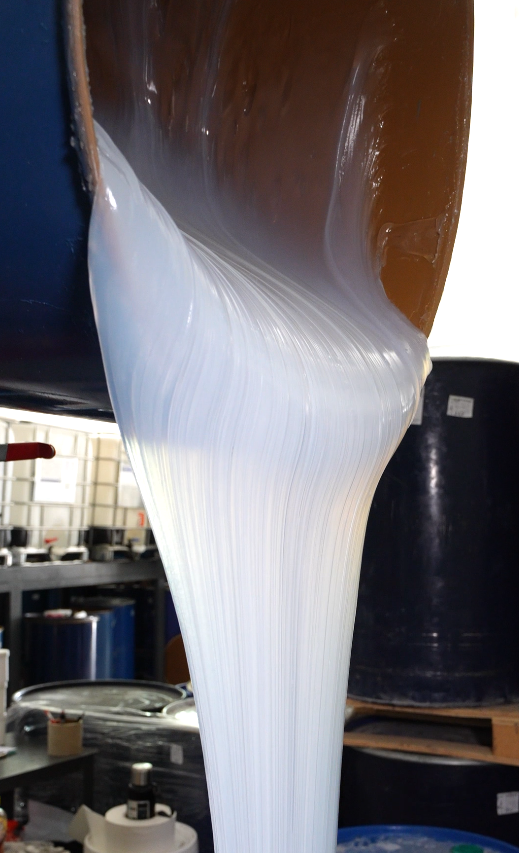
9. Adjustable Viscosity and Flow
Before curing, liquid silicone can be formulated with different viscosity and flow characteristics.
Low-viscosity silicone can flow into small gaps and reproduce fine details.
Higher-viscosity or thixotropic silicone can maintain its shape and reduce unwanted spreading.
Low-viscosity materials may be suitable for:
- Casting
- Encapsulation
- Fine molds
- Impregnation
- Automated dispensing
Higher-viscosity materials may be suitable for:
- Screen printing
- Thick coatings
- Raised designs
- Vertical-surface application
- Three-dimensional patterns
For textile screen printing, viscosity and thixotropy are especially important.
If the silicone flows too much, the design may spread beyond the intended edge.
If the material is too thick, it may be difficult to pass through the screen or level evenly.
The correct viscosity must match the screen mesh, printing thickness, equipment and required surface effect.
10. Fine Detail Reproduction
Liquid silicone can flow into detailed molds, screens and surface structures before curing.
This allows it to reproduce:
- Small text
- Fine patterns
- Surface textures
- Sharp edges
- Rounded edges
- Complex mold details
- Thin coating layers
This property is useful in precision molding, decorative printing, label production and mold making.
Detail reproduction depends on more than flowability.
Manufacturers must also control:
- Air bubbles
- Mold cleanliness
- Screen quality
- Material viscosity
- Curing speed
- Surface contamination
- Release conditions
A material that flows well may still produce poor detail if it contains bubbles or cures before completely filling the required area.
11. Customizable Surface Appearance
Liquid silicone can produce a wide range of surface effects.
Depending on the formulation and process, it can create:
- Transparent finishes
- Solid colors
- Matte surfaces
- Glossy surfaces
- High-gloss finishes
- Textured finishes
- Rounded three-dimensional effects
- Sharp-edged raised designs
For textile printing, different silicone systems may be used for different design requirements.
For example:
- Right-angle silicone can produce thick, raised patterns with defined edges.
- Round-edge silicone can create smoother and more rounded designs.
- Matte silicone provides a low-reflection finish.
- Glossy silicone creates a shiny surface.
The final appearance also depends on the release film, mold texture, screen, curing condition and printing technique.
12. Colorability
Liquid silicone can be colored with compatible silicone pigments.
Manufacturers can create:
- Standard colors
- Custom brand colors
- Transparent colors
- Fluorescent effects
- Metallic-looking effects
- Multi-layer color designs
Color matching is important for garment logos, consumer products and branded accessories.
The pigment must be compatible with the silicone curing system.
Incompatible or excessive pigment may cause:
- Incomplete curing
- Longer curing time
- Viscosity changes
- Reduced elasticity
- Color inconsistency
- Surface defects
For consistent mass production, pigment dosage should be measured accurately and recorded.
13. Adhesion Performance
Some liquid silicone formulations are designed to bond with fabrics, films, leather substrates, metals, plastics or other materials.
Adhesion is especially important in:
- Textile printing
- Silicone leather
- Intimate apparel
- Medical dressings
- Coated fabrics
- Composite products
- Electronic encapsulation
However, silicone does not naturally bond strongly to every surface.
Adhesion may be affected by:
- Substrate composition
- Surface coating
- Release agents
- Oil or dust contamination
- Surface energy
- Curing temperature
- Primer selection
- Bonding-layer formulation
Two fabrics with the same nylon or polyester composition may still produce different adhesion results because their surface treatments are different.
Testing should always be carried out on the actual production substrate.
14. Durability and Fatigue Resistance
Properly cured silicone can withstand repeated bending, stretching and compression.
This gives it good durability in products that experience frequent movement.
Examples include:
- Flexible garment decorations
- Wearable products
- Seals
- Membranes
- Keypads
- Elastic components
- Anti-slip patterns
Long-term durability depends on the combination of:
- Tensile strength
- Tear strength
- Elongation
- Hardness
- Adhesion
- Curing quality
- Product design
A thick silicone layer may appear strong but can still crack if it is too rigid for the substrate.
Similarly, highly elastic silicone may fail if its adhesion to the substrate is insufficient.
15. Resistance to Compression
Certain silicone materials offer good compression recovery.
This means the material can return toward its original shape after being compressed.
Compression performance is important for:
- Seals
- Gaskets
- Cushioning components
- Medical pads
- Protective components
- Industrial molded parts
For sealing applications, manufacturers often evaluate compression set.
Compression set measures how much permanent deformation remains after the material has been compressed for a specified time and temperature.
A lower compression set is generally preferred when long-term sealing performance is required.
16. Transparency
Some liquid silicone formulations can cure into transparent or translucent products.
Transparency is useful for:
- Optical components
- Medical products
- Encapsulation
- Decorative products
- Clear coatings
- Transparent molds
- Consumer products
The final clarity may be affected by:
- Filler type
- Pigment
- Mixing quality
- Air bubbles
- Product thickness
- Curing condition
- Surface texture
Transparent applications often require careful mixing and vacuum degassing to reduce visible bubbles.
17. Low Odor and Clean Curing
Platinum-cured liquid silicone can provide a relatively clean curing process with little or no reaction by-product.
This is beneficial for applications that require:
- Low odor
- Stable dimensions
- Clean surfaces
- Controlled curing
- Consistent performance
However, odor can also come from pigments, additives, solvents, cleaning agents or surrounding production materials.
Manufacturers should evaluate the complete process rather than assuming that every liquid silicone system is odor-free.
18. Biocompatibility Potential
Certain specially formulated and tested liquid silicone materials can be used in skin-contact, medical or healthcare applications.
Silicone is commonly selected for these fields because of its softness, flexibility and chemical stability.
However, biocompatibility is not a general property of every liquid silicone product.
Suitability for medical or skin-contact use depends on:
- Raw material control
- Formulation
- Manufacturing environment
- Extractable substances
- Curing completeness
- Required testing
- Intended contact duration
- Applicable regulations
A supplier should provide documentation that matches the specific application and target market.
Property Comparison: Liquid Silicone and Common Materials
The following table provides a general comparison. Actual performance varies by grade and formulation.
| Property | Liquid Silicone | PVC | Polyurethane | Conventional Rubber |
|---|---|---|---|---|
| Flexibility | Excellent | Adjustable | Excellent | Good |
| Temperature stability | Generally high | Moderate | Moderate | Depends on type |
| Weather resistance | Excellent | Moderate | Good | Depends on type |
| Soft-touch potential | Excellent | Good | Excellent | Good |
| Transparency | Available | Available | Available | Limited |
| Electrical insulation | Generally good | Good | Varies | Varies |
| Outdoor aging | Excellent | Moderate | Good | Varies |
| Processing form | Liquid before curing | Liquid or solid | Liquid or solid | Usually solid or liquid compound |
This table should only be used as a general reference.
The final material selection should be based on the actual product requirements, production process and test results.
How to Select Liquid Silicone Based on Required Properties
Before choosing a liquid silicone product, manufacturers should define the required performance clearly.
Important questions include:
- Does the product need to stretch?
- What hardness is required?
- Will it contact skin?
- What temperature will it experience?
- Will it be used indoors or outdoors?
- Does it need to bond with fabric, plastic or metal?
- Should the surface be matte, glossy or transparent?
- Does the material need to resist water or chemicals?
- What viscosity is suitable for the equipment?
- What curing temperature and time are available?
For textile printing, additional information should include:
- Fabric composition
- Fabric stretch
- Screen mesh
- Printing layers
- Required thickness
- Baking temperature
- Baking time
- Surface effect
- Washing requirements
Providing complete application information allows the supplier to recommend a more suitable material.
Frequently Asked Questions About Liquid Silicone Properties
Is liquid silicone always soft?
No. Liquid silicone can be formulated in a wide range of hardness levels. Some products are very soft, while others cure into firm rubber components.
Is liquid silicone resistant to high temperatures?
Many liquid silicone products offer good temperature resistance, but the exact limit depends on the formulation and application conditions.
Can liquid silicone stretch with fabric?
Special textile-printing silicone can stretch with fabric when the material hardness, adhesion and curing conditions are suitable.
Is liquid silicone waterproof?
Cured silicone generally has good water resistance. However, the complete product may not be waterproof if it contains gaps, weak seams or insufficient coating coverage.
Can liquid silicone be used outdoors?
Many silicone materials provide good ultraviolet, ozone and weather resistance, making them suitable for outdoor applications.
Can liquid silicone be colored?
Yes. Compatible silicone pigments can be used to produce custom colors. Pigment dosage must be controlled to avoid affecting curing and performance.
Does liquid silicone bond to every material?
No. Adhesion depends on the silicone formulation, substrate surface and processing conditions. Some applications require a primer, bonding layer or surface treatment.
Is all liquid silicone suitable for medical products?
No. Only materials with appropriate formulation, production control, testing and documentation should be used for medical or skin-contact applications.
Conclusion
Liquid silicone offers a valuable combination of flexibility, temperature resistance, weatherability, adjustable hardness, electrical insulation and customizable surface performance.
Its properties can be modified for textile printing, silicone leather, intimate apparel, medical dressings, electronics, molding and other industrial applications.
However, no single liquid silicone product is suitable for every process.
The correct material must match the substrate, equipment, curing conditions, required hardness, surface appearance and final product performance.
Chengyin Silicone develops liquid silicone materials for textile printing, intimate bonding, silicone leather and medical dressing applications.
To receive a suitable material recommendation, provide your substrate, production process, equipment, curing temperature, curing time and required performance. Our technical team can help evaluate the application and recommend an appropriate liquid silicone product for testing.